
473 kmD+ 10622 mMedian —
Arizona Monster 2027
Apr 2, 2027

Type its name, even approximately. We'll tell you right away if your plan is ready — measured profile, split times, weather at the hour, aid stations.
No rough estimates. When runners at your level have already raced the event, your split times are pulled straight from theirs; otherwise a model trained on 107,850 official results takes over. RAVIT then calculates your carbs, water and sodium needs segment by segment — and what you'll find at each aid station.
Profile, products and AI assistant free · Finish time and first checkpoints free on every race · Data hosted in France
Six questions, six short answers, and how to handle them on your race.
By breaking down total duration by elevation gain, night and fatigue — and where results exist, by copying what runners at your level did.
Read the answerRead the margin at each intermediate cut-off, stops included. The tightest one decides, never the average.
Read the answerWhat it will be at your checkpoint's altitude, during your arrival window — not the valley forecast or day-long average.
Read the answerEnough to reach the next resupply point, plus margin. Quantity comes from segment duration, never from distance.
Read the answerYes, in the plan itself, with write access — and your crew reads it via a link, no account needed.
Read the answerAt only those points the rules allow, with GPS coordinates and a time window, not a single time.
Read the answerA split time is calculated by projecting a total duration from a reference time, then splitting it by elevation gain, night and fatigue — never by kilometer ratio. On a race already run, real times from runners at your level give a far more accurate breakdown.
Three ways to calculate, the closest to real wins. Across 240 races, each segment's duration is copied from actual split times of runners in your index band, edition after edition. Elsewhere, a model trained on 45 races takes over. When no results exist, and only then, Riegel's law adjusted for elevation.
Compare your estimated split time at each intermediate cut-off, not just the one at the finish: it's almost always one of the intermediate ones that knocks you out. That margin is counted in clock time — running plus stops — and the only one that matters is the tightest on the course.
Two things eat into your margin without ever being counted. Aid station stops first: they're modeled separately from movement, on 1,667 stops measured across 103 stations. Night second, hour by hour. But “he went out too fast” doesn't hold up: at comparable level, fast starters don't drop out any more often.
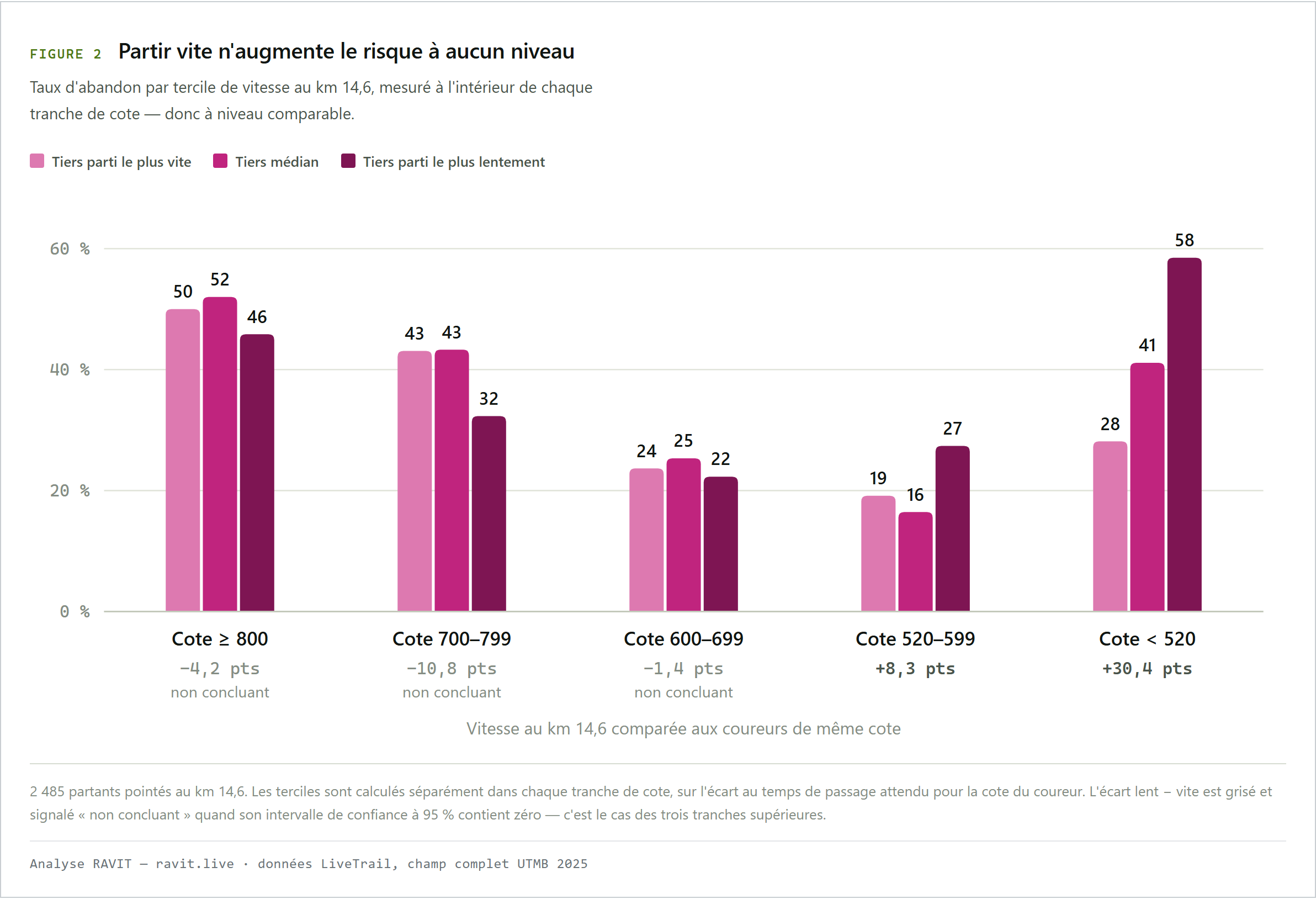
Read it with its limits: one edition, one race. It doesn't mean you should go out fast — early pace mostly reveals your form on the day, and a slow start is a symptom, not a cause. What does carry over is the method: the only pace that means anything is the one measured against your own index, not against the runner next to you. Read the full analysis: 2,493 starters, 828 dropouts
The weather that's useful to a trail runner is neither the valley's nor the day's: it's the temperature at the altitude of the checkpoint, over the window when you pass through it. The gap between the two runs to several degrees, and no model reaches beyond five days.
A model reports the temperature of the average terrain height in its grid cell, not the temperature at the pass: the correction uses the thermal lapse rate measured over the surrounding area. Three models are read — AROME, ICON, ECMWF IFS — and where they disagree, it is said plainly. Each segment keeps the worst moment of your arrival window, never an average.
All races with weather already calculated
Races in the next seven days, with their weather
RAVIT assistant
Because the figure comes from your time, not the distance. At an Index of 600 the model projects 33h45 on this course. At 60 g/h, that is 2,025 g. Your 1,400 g matches roughly 23 hours — the time of an Index 800 runner.
RAVIT assistant
You drop to 1,519 g, but you open a deficit of around 500 g over the race. Across 33 hours that is the classic third-quarter bonk. Better to aim for 60 g/h and train the tolerance.
You carry what covers the segment to the next point where you can restock, plus a margin — and nothing more, because every needless gram rides on your back for hours. The quantity comes from the segment's duration, never from its distance.
Aim for 60 to 90 g of carbs per hour beyond three hours of effort, 500 to 1,000 mL of fluid and 300 to 800 mg of sodium. Two traps cost dearly: a label lists salt when the target is sodium — a factor of 2.5 — and nausea ends more races than bonking.
Yes, in the plan itself, with write access: they fix the paces and targets that are wrong, and the reason for the change stays next to the line they edited. A spreadsheet sent by email, on the other hand, is out of date the moment the next change lands.
Three access types instead of one: editor for anyone correcting — coach, nutritionist —, observer for read-only follow, and public link for your crew, who open it with no account, in their language, trackside. Each access is removed with one click, and the link stays out of search unless you allow it.
Only at points where rules allow it; elsewhere, getting help can cost disqualification. At each of these points, your crew needs three things: GPS coordinates, a time window not a single time, and the list of what they're preparing.
Points where crew is allowed are read off the rules, station by station, and their coordinates interpolated onto your GPX track — a hamlet name can't be found at night. The roadbook separates what the team hands over on the spot from what you carry, and the times recalculate as soon as a pace changes.
It all starts with a GPX file and a list of aid stations. The elevation gain between two aid stations, the distance of each segment and the split time all work themselves out — you only enter what the race organizer publishes.
Enter your race (distance, elevation gain, aid stations), your profile (reference time, weight) and your nutrition targets (carbs, water, sodium). Adjust the strategy across the 4 quarters.
View the segment-by-segment nutrition table: estimated time, carb, water and sodium needs. Edit the times and pick your products.
Interactive course map and horizontal elevation profile with aid stations placed on the track, pace per segment and a sticky minimap.
Generate the race story for your crew: expected split times, products to prepare at each aid station and key points.
Get the full shopping list, quantified and grouped by product for the whole race.
UTMB, CCC, Diagonale des Fous, Marathon du Mont-Blanc, Templiers, Saintélyon… Search, filter, and access the profile, UTMB Index times and nutrition plan for every race.
2586 results
































The 248 races analyzed segment by segment, with your bib number
Your finish time, nutrition and first checkpoints are free on all your races. The full plan unlocks per race, or for 12 months.
For all your races
One-time payment
Your race organizer partners with RAVIT? Your full plan is free for their race.
Prices include all taxes, in your currency. The pass is paid once and does not renew.
30 to 60 g/h for a 1–3 hour effort, and 60 to 90 g/h beyond that. Going past 60 g/h requires a glucose-fructose blend and a gut used to it: that is training in its own right, to be built on long runs and never discovered on race day.
Roughly 500 to 700 mL/h in mild conditions, and 800 to 1,000 mL/h above 25 °C. Drinking to thirst remains the best guide: past 1 L/h without sodium, the risk of hyponatremia becomes real, especially on efforts over 12 hours.
300 to 800 mg/h depending on heat and sweat rate, and up to 1,000 mg/h for heavy sweaters in hot conditions. Sodium counts across everything you take in — drink, gels, broth, capsules — not just the salt capsules.
A liquid base covering most of the carbohydrate, topped up with solids while digestion holds, then savoury and liquid once it degrades. Over 12 to 20 hours, variety matters as much as quantity: flavour fatigue ends more races than bonking does.
It varies widely from race to race: some stations offer water only, others a partner brand's products, others a hot meal. RAVIT documents each one — availability, brand present, cut-off time, and where crew support is allowed.
Whatever covers the leg to the next crew point, plus a margin, and nothing more: an overstuffed bag costs you time. RAVIT builds the list per authorised point, with estimated arrival time and GPS coordinates for your team.
Appetite drops and alertness falls: shift to more liquid, more frequent and saltier intake, and plan for the low point between 3 and 5 a.m. RAVIT tells you what time you reach each segment based on your projected pace.
RAVIT starts from your UTMB® Index, then looks first for real split times: across 240 races, each segment's duration is copied from runners in your band, edition after edition. Failing that, a model trained on 45 races projects the breakdown. Riegel's law adjusted for elevation only kicks in as a last resort, when no results exist.
Each segment between two aid stations has its own duration, and therefore its own carbohydrate, fluid and sodium needs. Averaging across the whole race under-fuels the long climbs and overloads the short sections.
Your profile, nutrition targets, product catalog and AI assistant are free, with no subscription. On every race, your finish time, your nutrition and your first checkpoints are free. The full plan (all your split times, your cut-off margins, roadbook and wristband) unlocks per race, or for all your races for 12 months, with no auto-renewal. If you drop out or miss a cut-off, your race is refunded.
What matters is neither the valley forecast nor the day-long prediction, but the temperature at the altitude of the checkpoint, over the window when you actually pass through it. In the mountains the gap between the two runs to several degrees. Since the models only reach five days out, a forecast ten days ahead is not information.
Compare your estimated split time at each intermediate cut-off, not just the one at the finish: it's almost always one of them that knocks you out. The margin is counted in clock time, aid station stops included — five minutes at each of fifteen aid stations costs 1h15.
Your next race deserves better than a spreadsheet.
Enter your race and your UTMB® Index: RAVIT works out the rest, leg by leg.